Hodmedod: How a Pulse Business is Reimagining a Food System
An interview with Josiah Meldrum, outgoing Farming the Future Ambassador.

Sometimes, it’s asking the right question that changes everything.
Josiah Meldrum, William Hudson and Nick Saltmarsh are food activists who met as part of the
East Anglia Food Link in the early 2000s. Local to that area, they asked themselves an
experimental question - could a small city like Norwich (pop 150,000) feed itself? What might
need to change for that to happen?
“It was such a useful thought experiment,” says Josiah. What they found was that Norwich needed more horticultural land at the edge of
the city for market gardens. It needed to rebuild lost milling and cereal production capacity. And,
crucially, it would need to cut down on meat production.
But people also need protein. That was when pulses took over their imagination. Producing
more leguminous crops, such as beans, peas, chickpeas and lentils, would not only help fix
nitrogen in the soil but also provide useful edible protein. They discovered that local farmers
who produced peas or fava beans, either exported them or used them as animal feed.
The question then became - would people in Norwich eat pulses? They were popularly
stigmatized and associated with poverty and even the farmers who grew them, didn’t eat them.
So, they started cooking with pulses themselves. They created fun, hand-illustrated packaging
and sent them to food writers, chefs and other local organisations.
“We were building a community around pulses. We communicated provenance very clearly, for example, why not feature the farmer? Doing this was transformational. The farmer began to feel a sense of responsibility, they became a food producer. People began looking them up on social media. Food writers could engage with them.”
“With that simple transparency, we began to see how you can accelerate change,” he says.
Hodmedod, the trio’s highly successful, multiple award-winning pulse business, was born in
2012 – and it grew organically from there. Today, they employ more than 20 people and work
with up to 35 farmers from across the UK and France (for beans that can’t be grown locally) to
bring a variety of pulses to UK eaters. They’ve won numerous awards, including 23 Great Taste
Awards and Best Food Producer in the BBC’s 2017 Food and Farming Awards.
As they’ve grown, they’ve also championed a different, collaborative way of doing business.
“We’ve moved away from a linear conception of the food system to this model of a relational
web, where everyone can link to everyone else,” says Josiah.
Partly, this was out of necessity. As a small business, when they began, they quickly realised
they needed to build relationships with crop processors to interest them in their relatively tiny
amount. “We had to build a lot of social capital in order to get them on board,” says Josiah. In
this way, they managed to avoid having to invest in expensive infrastructure – and also started
growing a network of supporters.
By introducing farmers to each other, they also began to build a farmer network.
“In UK culture, collaboration can be hard, yet all farmers are oppressed by the commodity market. If you can overcome those barriers, it can facilitate change,”.
For example, they took a group of farmers to Sweden, to observe different farming practices – and, to simply hang out together.

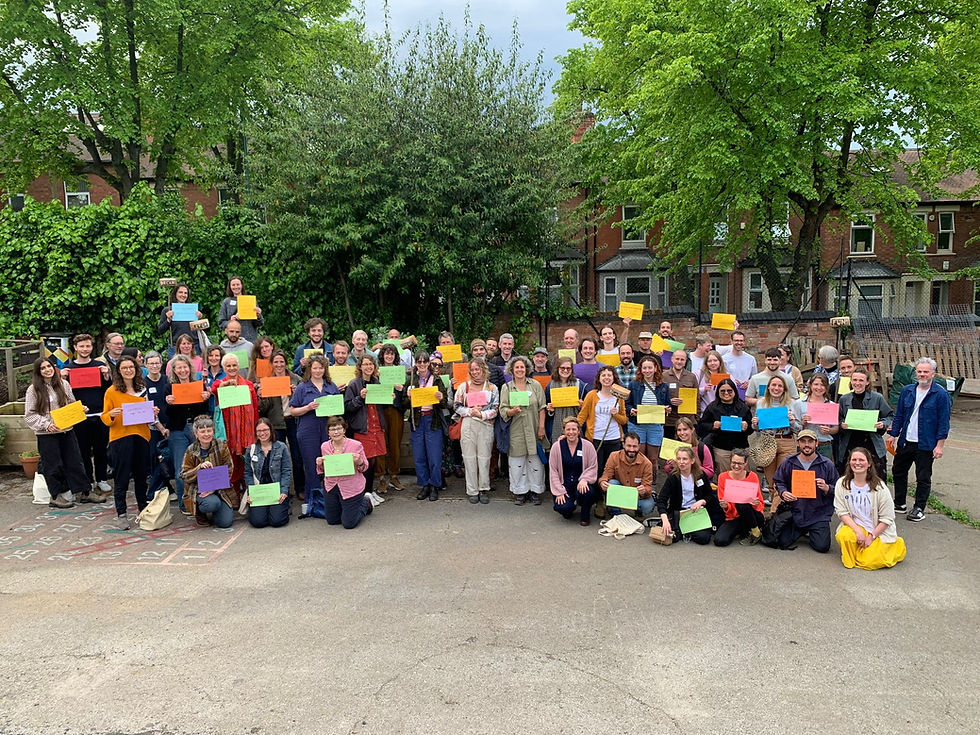
Collaboration, Josiah believes, is also an important benefit of Farming the Future, citing many
people he met, got to know and worked with as a result of his tenure as Ambassador. “Farming
the Future’s role in bringing all these people together and having them have conversations has
generated a lot of positive outcomes that are not going to be measured because they’re slightly intangible,” he says.
“It’s powerful. Farming the Future has a fantastic convening power that brings people together to support system change.”
Hodmedod continues to grow and evolve as it celebrates its 14th year. What started as a
question about feeding a city has grown into a web of people working differently together to
impact the food system. It’s become a business, a network, a public advocate and a new way of
working with farmers, distributors and eaters - proving that collaboration can build the new food
system we need.