Murmuration: how the Agroecology Communications Network is helping the sustainable food sector find its voice

Leonie Nimmo has a word for what the Agroecology Communications Network (ACN) does. "I've come to see it as a murmuration approach," she says. Like a flock of birds, each small and perhaps individually vulnerable, moving together with a collective force greater than the sum of their parts. "Together we're stronger and more of a force to be reckoned with."
Nimmo is head of GM Freeze, the anti-GM campaigning group, and an active member of the ACN, a loose coalition of farmers, campaigners and organisations publicly advocating for a more sustainable food system, supported by Farming the Future. She knows better than most what it feels like to operate as a small organisation in a sector that is often under-resourced and frequently overlooked by mainstream media.
"The small farming sector is so squeezed financially that there is very little money to play with in terms of attending events or having time to engage with communications," she says.
"The way the ACN goes about it is great because it allows for participation from people who might otherwise struggle."
Being an organic farmer or small-scale food campaigner, she adds, can be a solitary, even lonely, existence. "The ACN came out of a recognition of a need for support and advocacy for farmers and others engaged in this work."
Getting into the room
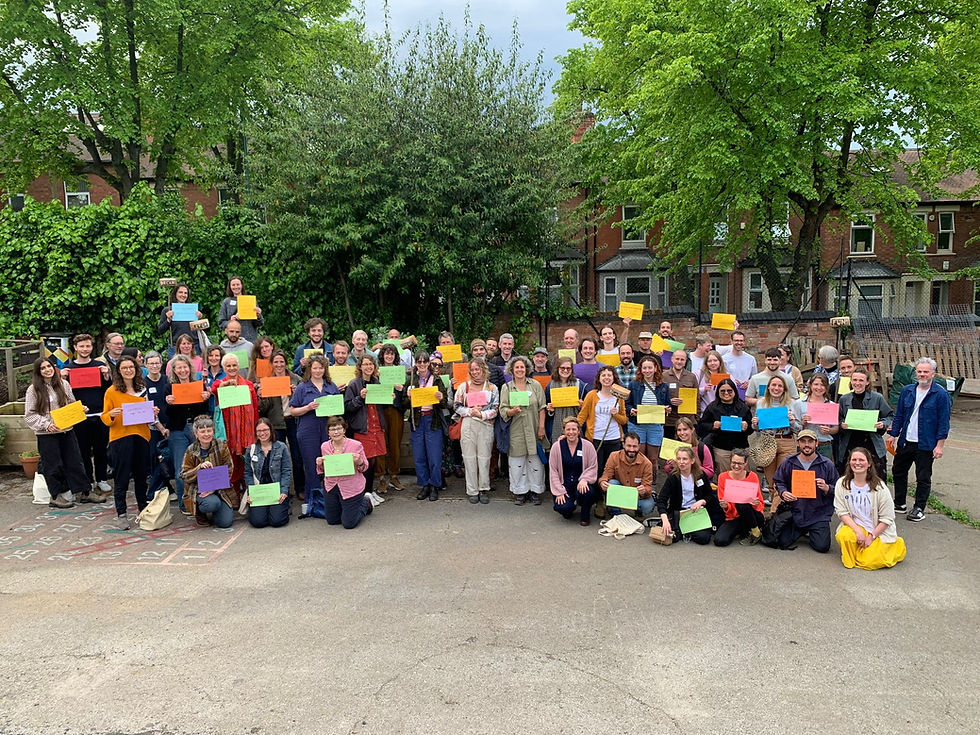
One of the network's most practical tools is organising collaborative meetings between journalists and more than 70 organisations that are part of the ACN, including independent food producers. This creates the conditions for a free flow of information that wouldn't otherwise happen. At a 2024 event, for example, Nimmo found herself in conversation with a journalist from Sustainable Views, an FT publication. The result was a feature on the Precision Breeding Act, legislation that, as she notes, "mainstream media had barely touched,".
The ACN has helped her develop a clearer understanding of what journalists actually need, and how to deliver it to them. It has also done something harder to quantify for the agroecology movement, and that is build confidence. "It lets all these smaller organisations know that they're not alone. That kind of networking is really useful."
The bigger picture
That sense of collective strength has tangible consequences. This month brought a significant legal victory for the wider sector. In response to a case led by Beyond GM, a UK High Court ruled that the government's controversial gene editing regulations were based on incorrect advice, finding that the Farming Minister had been wrongly advised about his own legal powers. Pushing the rules on that basis, the Court concluded, was irrational and unlawful.
"This is a major, major win," says Nimmo.
What made it particularly notable was something the Court recognised for the first time in case law: that organic farming is not merely a technical standard or certification scheme. For many who practice it, it represents a distinct set of values, principles and professional commitments that the new regulations would make much harder to maintain. The testimony of two organic farmers, speaking to what organic agriculture means as a way of life rather than a set of rules to follow, was taken seriously by the Court.
"One of the challenges for this sector is to communicate the love and passion for what people do," says Nimmo. "That was acknowledged."
A murmuration
Individual organisations, each small and financially stretched, can struggle to navigate a system with enormous inertia. But moving together means they are connected, more responsive, and louder.
"Maybe what the ACN does," says Nimmo, "is support a murmuration approach for this whole sector."
It’s an image worth sitting with. A murmuration doesn’t have a leader because it doesn’t need one. It just needs enough birds moving in the same direction to create results.